
Table of Contents
Introduction
A Domicile Certificate is an essential government-issued document that serves as proof of an individual’s permanent residence in a particular state or union territory of India. It plays a crucial role in accessing various state-specific benefits and opportunities, including educational admissions, government employment, scholarships, and welfare schemes. Many institutions and government departments require applicants to submit a domicile certificate to verify their eligibility for reserved quotas and local resident benefits.
Whether you are a student seeking admission under a state quota, a job seeker applying for government positions, or an individual looking to avail government welfare programs, possessing a valid Domicile Certificate can be highly beneficial. The certificate helps establish your legal residential status and ensures that you receive the advantages and privileges offered by your state government.
However, applying for a domicile certificate requires proper understanding of the eligibility criteria, necessary documentation, application procedures, and verification processes. In this comprehensive guide, you will learn everything about the Domicile Certificate, including its importance, benefits, required documents, application process, processing time, and useful tips for obtaining it quickly and successfully. This information will help you complete the application process smoothly and avoid unnecessary delays.
What is a Domicile Certificate?
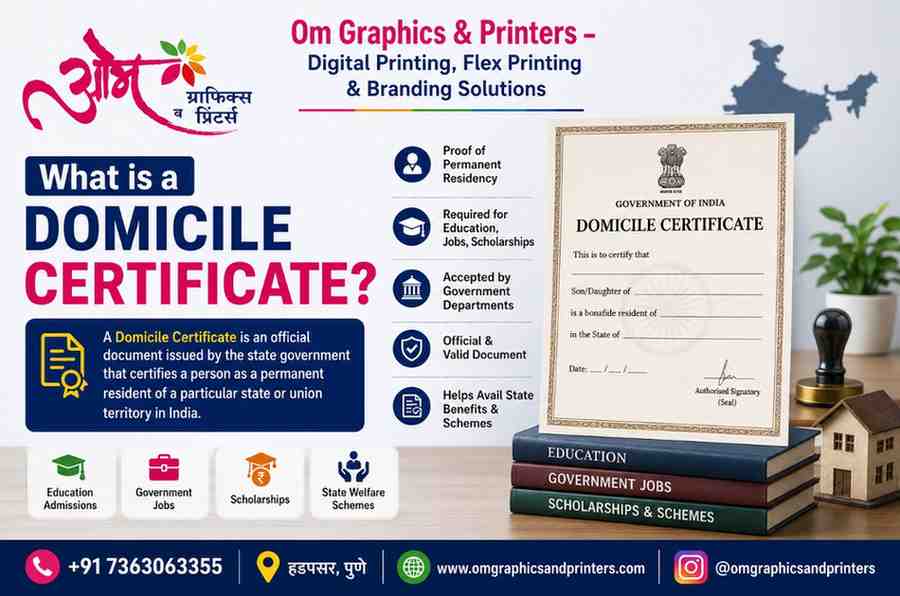
A Domicile Certificate is an official document issued by the state government certifying that an individual is a permanent resident of that state. It serves as proof of residence and is often required to avail various government benefits and opportunities reserved for residents of a particular state.
The certificate is issued by authorized government departments such as:
- Revenue Department
- District Magistrate Office
- Tehsildar Office
- Sub-Divisional Magistrate (SDM)
- Citizen Service Centers
Importance of a Domicile Document
A Domicile Certificate is essential for various purposes, including:
1. Educational Admissions
Many state universities and educational institutions reserve seats for local residents. A domicile certificate helps students claim these reservations.
2. Government Jobs
Several state government recruitment processes require applicants to provide proof of domicile.
3. Scholarships
Many scholarships offered by state governments are available only to domicile residents.
4. Welfare Schemes
State-specific welfare programs often require domicile proof to verify eligibility.
5. Property and Legal Matters
A domicile certificate may be required during property transactions, legal proceedings, and inheritance matters.
Benefits of Having a Domicile Document
Obtaining a Domicile Certificate offers numerous advantages:
Access to Reserved Seats
Students can avail reservation benefits in educational institutions.
Eligibility for State Scholarships
Many state-funded scholarship programs require domicile proof.
Government Employment Opportunities
Candidates can apply for state-specific government jobs.
Participation in Welfare Schemes
Residents can access financial assistance and welfare benefits.
Simplified Verification Process
The certificate acts as a recognized proof of permanent residence.
Eligibility Criteria for Domicile Document
The eligibility requirements may vary slightly from one state to another. However, common criteria include:
Permanent Residency
The applicant must be a permanent resident of the state.
Minimum Residency Period
Most states require the applicant to have resided in the state continuously for a specific number of years.
Parent’s Residency
For minors, the domicile status of parents is generally considered.
Property Ownership (Where Applicable)
Some states may consider property ownership as supporting evidence.
Documents Required for Domicile Document
To apply for a Domicile Certificate, applicants usually need the following documents:
Identity Proof
- Aadhaar Card
- PAN Card
- Voter ID Card
- Passport
Address Proof
- Electricity Bill
- Water Bill
- Ration Card
- Rent Agreement
Residency Proof
- School Leaving Certificate
- Birth Certificate
- Residence Certificate
- Property Documents
Passport Size Photographs
Recent passport-size photographs may be required.
Application Form
A duly filled application form issued by the concerned authority.
How to Apply for a Domicile Document?
The application process can be completed either online or offline depending on the state’s services.
Online Application Process
Step 1: Visit the State Portal
Visit the official state government service portal.
Step 2: Register Yourself
Create a user account using your mobile number and email address.
Step 3: Fill the Application Form
Enter personal details such as:
- Name
- Address
- Date of Birth
- Parent Information
- Residency Details
Step 4: Upload Documents
Upload scanned copies of required documents.
Step 5: Submit Application
Review the details and submit the application.
Step 6: Pay Applicable Fees
Some states charge a nominal processing fee.
Step 7: Track Application Status
Use the application number to monitor progress.
Offline Application Process
Applicants can also apply through:
- Tehsildar Office
- District Collector Office
- Revenue Department Office
- Common Service Centers (CSC)
Steps:
- Obtain the application form.
- Fill in the required details.
- Attach supporting documents.
- Submit the application.
- Collect the acknowledgment receipt.
- Wait for verification and approval.
Processing Time for Domicile Certificate
The processing time for a Domicile Certificate generally ranges from 7 to 30 working days, depending on the state government’s rules and verification procedures. While some states offer faster online processing through digital service portals, others may take additional time due to manual verification and administrative approvals.
Several factors influence how quickly a domicile certificate is issued. One of the most important factors is document verification. Authorities carefully review the applicant’s identity proof, address proof, and residency documents to ensure eligibility. If any document is missing, unclear, or contains incorrect information, the application may be delayed.
Another factor is the volume of applications being processed by the concerned department. During admission seasons, recruitment drives, or scholarship application periods, government offices may receive a large number of requests, increasing processing times.
How to Check Domicile Certificate Status?
Most state government portals provide an online tracking facility.
You can check status using:
- Application Number
- Registration Number
- Mobile Number
The portal displays:
- Under Verification
- Approved
- Rejected
- Certificate Generated
Common Reasons for Application Rejection
Applications may be rejected due to:
Incorrect Information
Providing inaccurate details can lead to rejection.
Incomplete Documents
Missing mandatory documents often result in delays or rejection.
Insufficient Residency Proof
Failure to establish permanent residence can affect approval.
Mismatched Records
Discrepancies in submitted documents may trigger rejection.
How to Download a Domicile Certificate?
After approval:
- Visit the state government portal.
- Log in to your account.
- Navigate to issued certificates.
- Select the domicile certificate.
- Download the PDF copy.
- Print for future use.
Many certificates now include QR codes for digital verification.
Difference Between Domicile Certificate and Residence Certificate
Many people confuse these two documents.
| Domicile Certificate | Residence Certificate |
|---|---|
| Proves permanent residency | Proves current residence |
| Used for state benefits | Used for address verification |
| Long-term association with state | Temporary or current address proof |
| Required for state quotas | Required for general verification |
Understanding the difference helps applicants choose the correct document.
Uses of Domicile Certificate in Education
Students frequently require a Domicile Certificate for:
- College admissions
- Engineering admissions
- Medical admissions
- State quota seats
- Scholarship applications
- Entrance examinations
Educational institutions use the certificate to verify eligibility for reserved categories and local quotas.
Uses of Domicile Certificate in Employment
A Domicile Certificate plays a vital role in:
- State government jobs
- Local recruitment drives
- Public sector employment
- Reserved employment opportunities
Many recruitment notifications specifically mention domicile requirements.
Tips for Quick Approval
To improve approval chances:
Verify Information
Double-check all details before submission.
Upload Clear Documents
Ensure all scanned documents are legible.
Use Updated Documents
Submit valid and recent proofs.
Follow State Guidelines
Review state-specific eligibility requirements carefully.
Keep Copies
Maintain copies of all submitted documents.
Why Choose Om Graphics & Printers?
At Om Graphics & Printers, we assist customers with document-related services, application support, printing solutions, photocopies, scanning, online form filling, and government service documentation requirements.
Our services include:
- Online Application Assistance
- Document Printing
- Scanning Services
- Xerox & Photocopy
- Lamination
- Digital Printing
- Flex Printing
- Government Form Assistance
We aim to provide fast, reliable, and customer-friendly services for all your documentation needs.
Conclusion
A Domicile Certificate is an essential document for students, job seekers, and citizens who wish to avail state-specific benefits and opportunities. Whether you need it for education, employment, scholarships, or welfare schemes, understanding the application process and documentation requirements can make the procedure simple and hassle-free.
Before applying, ensure that all documents are accurate and complete to avoid delays. With proper preparation, obtaining a Domicile Certificate becomes a straightforward process that opens the door to numerous opportunities and government benefits.
Frequently Asked Questions (FAQs) About Domicile Document
1. What is a Domicile Document?
A Domicile Documentis an official document issued by a state government that confirms a person’s permanent residence in a particular state or union territory of India. It serves as legal proof that an individual belongs to that state and is eligible for various state-specific benefits. The certificate is commonly required for educational admissions, government jobs, scholarships, welfare schemes, and other official purposes. Since many state government programs are designed specifically for local residents, the domicile certificate helps authorities verify eligibility. It is issued by designated government authorities such as the Tehsildar, District Magistrate, Sub-Divisional Magistrate (SDM), or Revenue Department after proper verification of residency documents.
2. Why is aDomicile Document important?
A Domicile Document
is important because it allows residents to access numerous state-level benefits and opportunities. Educational institutions often reserve seats for local students, while government departments may reserve jobs for candidates who belong to a particular state. The certificate is also required for applying for scholarships, welfare schemes, and financial assistance programs offered by state governments. Additionally, it may be needed for legal documentation, property-related matters, and various administrative procedures. Without a valid domicile certificate, applicants may not be able to claim state quotas or benefits that are specifically intended for permanent residents of that region.
3. Who is eligible to apply for a Domicile Document?
Eligibility criteria for a Domicile Certificate vary from state to state. Generally, an applicant must have been residing in the state for a specified number of years as prescribed by the respective government. In many cases, the applicant or their parents must be permanent residents of the state. Students born and educated in a state may also qualify under specific conditions. For minors, the domicile status of their parents is usually considered. Some states may require proof of continuous residence, property ownership, or educational records to establish domicile status. Applicants should always verify the specific eligibility requirements applicable in their state before applying.
4. What documents are required for a Domicile Document?
To obtain a Domicile Certificate, applicants typically need to provide several supporting documents. These may include identity proof such as an Aadhaar Card, PAN Card, Passport, or Voter ID. Address proof like electricity bills, ration cards, water bills, or rent agreements is also commonly required. Additional residency documents such as school leaving certificates, birth certificates, property papers, or residence certificates may be requested to establish permanent residence. Passport-size photographs and a completed application form are usually mandatory. The exact document requirements vary by state, so applicants should consult the relevant government portal or local authority before submitting their application.
5. How can I apply for a Domicile Document online?
Many state governments now offer online application facilities for obtaining a Domicile Certificate. Applicants can visit the official state service portal, register an account, and fill out the online application form. They must provide personal information, residential details, and upload scanned copies of the required documents. After completing the form and paying any applicable fees, the application can be submitted electronically. The applicant receives a reference number that can be used to track the status of the application. Once the verification process is completed and approved, the domicile certificate can often be downloaded directly from the portal.
6. How long does it take to get a Domicile Document?
The processing time for a Domicile Certificate generally ranges from 7 to 30 working days, depending on the state government’s procedures and workload. Online applications may be processed faster in states with advanced digital systems, while manual verification processes may take longer. Delays can occur if documents are incomplete, unclear, or require additional verification. During peak periods such as admission seasons or recruitment drives, authorities may receive a high volume of applications, increasing processing times. Applicants can speed up the process by ensuring all information is accurate and all required documents are submitted correctly.
7. Can a Domicile Document be used for educational admissions?
Yes, a Domicile Certificate is widely used for educational admissions, especially when applying under state quotas or reserved categories. Many government and private educational institutions reserve a percentage of seats for students who are permanent residents of the state. The certificate helps verify eligibility for these reserved seats and ensures that local students receive priority benefits. It is also frequently required when applying for state-funded scholarships, fee concessions, and educational assistance programs. Students seeking admission to engineering, medical, law, and other professional courses often need to submit a domicile certificate during the admission process.
8. What is the difference between a Domicile Certificate and a Residence Certificate?
Although they are often confused, a Domicile Certificate and a Residence Certificate serve different purposes. A domicile certificate establishes that an individual has a permanent legal connection to a specific state and intends to reside there permanently. It is generally used for educational admissions, government jobs, and state-specific benefits. A residence certificate, on the other hand, merely proves that a person currently lives at a particular address. It may be used for local verification purposes, utility services, and general address proof. A residence certificate does not necessarily indicate permanent residency or eligibility for state-specific benefits.
9. What should I do if my Domicile Certificate application is rejected?
If your Domicile Certificate application is rejected, you should first review the reason provided by the issuing authority. Common reasons include incomplete documentation, incorrect information, insufficient residency proof, or mismatched records. After identifying the issue, gather the necessary supporting documents and correct any errors in the application. Most government portals provide an option to reapply or submit additional information. If you believe the rejection was incorrect, you may contact the concerned authority or visit the local office for clarification. Ensuring that all details are accurate and properly documented can significantly improve the chances of approval upon reapplication.
10. Is a Domicile Certificate valid for a lifetime?
In many states, a Domicile Certificate remains valid for a long period and may effectively serve as permanent proof of domicile unless specific state regulations require renewal. However, validity rules can vary depending on the issuing authority and the purpose for which the certificate is being used. Some educational institutions, recruitment agencies, or government departments may request a recently issued certificate during the application process. Therefore, applicants should verify the validity requirements applicable to their situation. Keeping a digital and printed copy of the certificate is recommended, as it may be needed repeatedly for admissions, employment, scholarships, and various government services in the future.