
Table of Contents
Introduction
Starting and operating a business requires more than choosing a product, finding customers, and managing daily operations. Businesses also need to understand applicable tax requirements, maintain proper records, issue appropriate invoices, and complete necessary registrations. For eligible businesses, GST Registration in Hadapsar can be an important step toward establishing a compliant and organized business structure.
The Goods and Services Tax (GST) is an indirect tax system applicable to the supply of goods and services in India. GST registration provides an eligible business with a GST Identification Number (GSTIN) and enables the registered person or entity to undertake GST-related compliance according to applicable rules.
For entrepreneurs, retailers, service providers, traders, manufacturers, freelancers, startups, and other businesses operating in Hadapsar and Pune, understanding GST registration requirements can make tax-related processes easier to manage.
This comprehensive guide explains the basics of GST Registration in Hadapsar, eligibility considerations, documents, registration steps, benefits, common mistakes, and related compliance requirements.
What Is GST Registration?
GST registration is the process through which an eligible person or business registers under India’s Goods and Services Tax system. After successful registration, the taxpayer receives a unique GSTIN.
The GSTIN is generally used on tax invoices and in GST-related filings and communications.
Depending on the nature and circumstances of the business, GST registration may apply to different types of taxpayers. The applicable registration requirements can depend on factors such as turnover, type of supply, business activity, location, and specific provisions under GST law.
Before applying, businesses should determine whether registration is mandatory or whether voluntary registration is appropriate for their circumstances.
For businesses seeking GST Registration in Hadapsar, understanding these requirements before submitting an application can help reduce errors and unnecessary delays.
Why Is GST Registration Important for Businesses?
GST registration can provide an organized framework for businesses that are required to comply with GST provisions.
A registered business may be able to:
- Issue GST-compliant tax invoices
- Collect applicable GST from customers
- Claim eligible input tax credit
- Participate in applicable business-to-business transactions
- Maintain formal GST records
- Complete applicable GST returns
- Use its GSTIN for business documentation
The exact benefits and obligations depend on the taxpayer’s circumstances and applicable GST rules.
Businesses considering GST Registration in Hadapsar should understand both the advantages and the ongoing compliance responsibilities before registering.
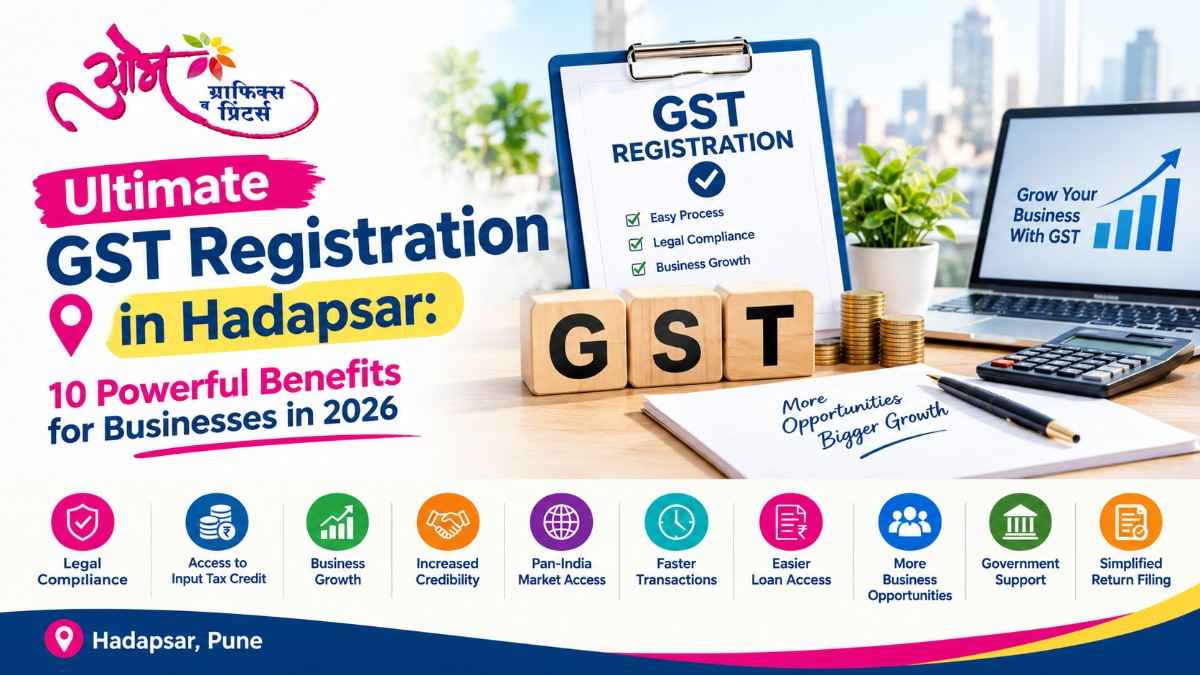
10 Powerful Benefits of GST Registration
1. Establishes Formal GST Identity
One important outcome of registration is obtaining a GSTIN. This provides the business with a formal identity within the GST system.
A GSTIN may be required on invoices, documents, and GST-related communications. It can also make it easier for customers and business partners to verify GST-related information.
For eligible businesses, GST Registration in Hadapsar can therefore form an important part of establishing a structured tax-compliance process.
2. Enables GST-Compliant Invoicing
Registered taxpayers can issue tax invoices containing the information required under applicable GST rules.
Proper invoices can include details such as:
- Supplier information
- GSTIN
- Customer information
- Invoice number
- Invoice date
- Description of goods or services
- Taxable value
- Applicable GST rate
- GST amount
- Total invoice value
Businesses seeking GST Registration in Hadapsar should also understand invoice requirements applicable to their specific business activities.
3. Supports Eligible Input Tax Credit
Input Tax Credit (ITC) is an important feature of the GST system. Subject to applicable conditions and restrictions, an eligible registered taxpayer may be able to claim credit for GST paid on qualifying business purchases.
Proper invoices, records, and compliance are important for claiming eligible credit.
Businesses considering GST Registration in Hadapsar should maintain appropriate purchase and sales records and understand the conditions governing ITC.
4. Helps With Business-to-Business Transactions
Many businesses prefer working with suppliers and service providers that maintain proper tax documentation.
A GST-registered business can provide its GSTIN and issue applicable tax invoices, making GST-related business transactions more structured.
For companies supplying other registered businesses, GST Registration in Hadapsar may therefore be relevant to their commercial operations.
5. Supports Business Expansion
As a business grows, its customer base, sales channels, suppliers, and geographic reach may also expand.
Maintaining appropriate tax registrations can help create a more organized business structure.
Entrepreneurs considering GST Registration in Hadapsar should assess their present requirements as well as their expected business activities and growth.
6. Improves Record-Keeping
GST compliance involves maintaining relevant sales, purchase, invoice, and tax records.
Organized records can help businesses monitor transactions and prepare required information for GST compliance.
A business undertaking GST Registration in Hadapsar should establish a system for storing invoices and maintaining accurate financial records from the beginning.
7. Builds Professional Business Documentation
Formal tax documentation can contribute to a structured business process.
GSTIN details, tax invoices, purchase records, and other documents may be required when dealing with customers, suppliers, financial institutions, or professional advisors.
For many businesses, GST Registration in Hadapsar can therefore be one component of maintaining professional business documentation.
8. Supports Applicable E-Commerce Activities
Businesses selling through certain e-commerce platforms may have GST-related obligations depending on their activities and the applicable rules.
Online sellers should carefully evaluate their GST position before starting or expanding e-commerce operations.
Anyone considering GST Registration in Hadapsar for an online business should check the current GST requirements applicable to their particular business model.
9. Helps Maintain Tax Compliance
GST registration also creates ongoing responsibilities. Depending on the taxpayer category, registered businesses may need to file applicable returns, maintain records, issue compliant invoices, and meet other requirements.
Proper compliance can help businesses avoid unnecessary tax-related issues.
Professional assistance with GST Registration in Hadapsar can help business owners understand registration and compliance requirements, although the taxpayer remains responsible for the accuracy of information submitted and compliance undertaken.
10. Creates a Structured Tax Process
GST registration is not simply about obtaining a GSTIN. It is part of a broader system involving invoicing, accounting, returns, records, and tax payments.
Businesses that establish appropriate systems early can manage these requirements more efficiently.
For an eligible entrepreneur, GST Registration in Hadapsar can be an important part of creating an organized tax-compliance process.
Who May Need GST Registration?
GST registration requirements depend on the taxpayer’s circumstances and applicable provisions. Businesses should not assume that every business has identical registration obligations.
Potentially relevant categories may include:
- Traders
- Manufacturers
- Service providers
- Retailers
- Wholesalers
- Certain freelancers
- E-commerce businesses
- Businesses making certain inter-State supplies
- Other persons covered by specific GST provisions
Turnover thresholds and compulsory-registration provisions can vary depending on circumstances.
Anyone seeking GST Registration in Hadapsar should verify the current rules applicable to their business before submitting an application.
GST Registration for Small Businesses
Small businesses often have questions about whether registration is necessary, what documents are needed, and what compliance follows registration.
A small retailer, consultant, trader, service provider, or other entrepreneur should first evaluate:
- Annual turnover
- Type of goods or services
- Location of business
- Nature of customers
- Inter-State supplies
- E-commerce activities
- Applicable GST provisions
For entrepreneurs considering GST Registration in Hadapsar, reviewing these factors can help determine the appropriate registration approach.
GST Registration for Startups
Startups often focus on products, customers, investment, marketing, and growth. Tax compliance may become complicated if registration and record-keeping are not considered early.
A startup should maintain appropriate business documentation from the beginning, including invoices, purchase records, expense records, and customer information.
If registration is required or otherwise appropriate, GST Registration in Hadapsar can become part of the startup’s formal business setup process.
GST Registration for Traders
Traders purchase and sell goods and may deal with multiple suppliers and customers.
Maintaining proper purchase invoices and sales invoices is particularly important for businesses that need to track taxable transactions and applicable GST.
A trader seeking GST Registration in Hadapsar should organize business documents and ensure that the information submitted during registration is accurate.
GST Registration for Service Providers
Consultants, agencies, professionals, repair businesses, technology companies, freelancers, and other service providers may have GST-related obligations depending on their circumstances.
Service providers should maintain clear records of:
- Customer details
- Service descriptions
- Invoices
- Payments
- Expenses
- Applicable taxes
For eligible service providers, GST Registration in Hadapsar can help establish a formal GST identity.
Documents Commonly Required for GST Registration
The exact documentation can depend on the type of taxpayer and business structure. Commonly requested documents may include:
PAN
PAN is an important identification document for GST registration.
Aadhaar
Aadhaar-related verification may apply depending on the registration process and circumstances.
Business Address Proof
Documents may be required to establish the principal place of business.
Bank Account Details
Bank-related information may be required as part of GST registration or subsequent compliance.
Photographs
Photographs may be required for relevant promoters, proprietors, partners, or authorized persons.
Business Constitution Documents
Depending on the business structure, documents may include partnership deeds, incorporation documents, trust documents, or other applicable records.
Applicants seeking GST Registration in Hadapsar should verify the current document requirements before submitting their application.
GST Registration Process
The registration process generally involves submitting required information through the GST system and completing applicable verification procedures.
Step 1: Determine Eligibility
First, evaluate whether GST registration is mandatory or whether voluntary registration is appropriate.
Step 2: Collect Documents
Prepare PAN, identity documents, business address proof, business constitution documents, bank information, and other applicable documents.
Step 3: Submit Registration Details
Provide the required business and promoter information through the prescribed GST registration process.
Step 4: Complete Verification
Applicable verification or authentication requirements must be completed.
Step 5: Application Processing
The application is reviewed according to the applicable GST process.
Step 6: Receive GSTIN
Once registration is successfully completed, the taxpayer receives the applicable GST registration details.
For customers seeking GST Registration in Hadapsar, accurate information and properly prepared documents can help make the application process smoother.
Common GST Registration Mistakes
Businesses sometimes face problems because of incomplete or inconsistent information.
Common mistakes include:
Incorrect PAN Information
PAN details should be entered accurately.
Wrong Business Address
The business address should match the supporting documentation.
Incorrect Legal Name
The legal name should correspond with relevant official records.
Poor Document Quality
Unreadable or incomplete documents can create issues during verification.
Incorrect Bank Information
Bank details should be checked carefully.
Inconsistent Information
Details across PAN, identity documents, business records, and application information should be consistent where required.
Businesses applying for GST Registration in Hadapsar should review their application carefully before submission.
GST Registration and Tax Invoices
After registration, businesses need to understand the applicable invoice requirements.
Depending on the transaction, a GST invoice may contain:
- Supplier name
- Supplier address
- GSTIN
- Invoice number
- Invoice date
- Customer details
- Product or service description
- Quantity
- Taxable value
- GST rate
- Tax amount
- Total value
Businesses should ensure that invoices are prepared according to applicable GST requirements.
GST Returns After Registration
GST registration is generally accompanied by ongoing compliance obligations. The specific returns and frequency can depend on the taxpayer’s registration type and applicable rules.
Businesses should maintain:
- Sales records
- Purchase records
- Tax invoices
- Credit notes
- Debit notes
- Payment records
- Relevant GST documents
A taxpayer using GST Registration in Hadapsar should not consider registration as the end of the process. Ongoing compliance is an important part of GST management.
GST Registration vs GST Return Filing
These two services are different.
GST Registration
Registration creates the taxpayer’s GST identity and results in GST registration details when successfully completed.
GST Return Filing
Return filing involves reporting applicable transactions and tax information according to the taxpayer’s filing requirements.
A business may need both registration and ongoing return compliance depending on its circumstances.
Therefore, anyone obtaining GST Registration in Hadapsar should also understand the compliance responsibilities that may follow.
GST Amendment Services
Business information can change over time. For example, a business may change its address, contact information, partners, authorized signatory, or other details.
Certain changes may require updating GST registration information according to applicable procedures.
Businesses should review whether a change requires an amendment and complete the relevant process when necessary.
GST Cancellation
In certain circumstances, a taxpayer may become eligible or required to cancel GST registration according to applicable provisions.
Cancellation can involve specific procedures and compliance requirements. Businesses should not simply stop using a GSTIN without understanding the applicable cancellation process.
A business that previously completed GST Registration in Hadapsar should obtain appropriate professional guidance if it needs to consider cancellation.
GST Compliance for Growing Businesses
As a business grows, its transaction volume can increase significantly. More customers and suppliers can mean more invoices, purchases, expenses, payments, and tax records.
Businesses should consider using accounting systems and organized document-management processes.
A growing business that completed GST Registration in Hadapsar should periodically review its compliance process to ensure records remain accurate and up to date.
GST Registration for Different Business Structures
GST registration may apply to different types of business entities.
Proprietorship
A sole proprietor may operate a business under their individual legal identity.
Partnership
A partnership firm may require relevant partnership documentation and partner information.
Private Limited Company
A company generally has separate legal documentation and authorized persons for tax-related matters.
LLP
Limited Liability Partnerships have their own incorporation and business documentation.
Other Organizations
Trusts, societies, and other entities may have specific documentation requirements depending on their activities.
The exact GST registration requirements depend on the legal structure and applicable provisions.
Why Professional Assistance Can Help
GST registration involves entering business information, uploading documents, completing verification, and understanding applicable compliance requirements.
Professional assistance can help businesses:
- Understand the application process
- Organize documents
- Review information
- Identify common errors
- Understand post-registration requirements
- Maintain better compliance records
Businesses looking for GST Registration in Hadapsar can consider obtaining assistance from a qualified tax professional or service provider.
However, professional assistance does not replace the taxpayer’s responsibility to provide accurate information and meet applicable legal requirements.
GST Registration for E-Commerce Businesses
Online businesses can have additional GST considerations depending on how they sell goods or services.
Businesses using marketplaces, websites, social-commerce channels, or other online platforms should examine the rules applicable to their specific business model.
Before seeking GST Registration in Hadapsar, an online business should evaluate its sales channels, customer locations, products or services, turnover, and applicable provisions.
GST Registration and Business Credibility
A formal tax registration can be an important component of business documentation. Customers and business partners may request GST information when entering commercial relationships.
A GSTIN can also be displayed on applicable business invoices and documents.
For eligible businesses, GST Registration in Hadapsar can therefore support a more structured approach to business documentation.
Maintaining GST Records
Good record-keeping is important for GST compliance.
Businesses should maintain relevant:
- Sales invoices
- Purchase invoices
- Expense records
- Credit notes
- Debit notes
- Payment records
- Bank records
- GST returns
- Registration documents
Digital record-keeping can make it easier to locate documents when needed.
A business with GST Registration in Hadapsar should develop a consistent system for organizing these records.
GST Registration for Local Hadapsar Businesses
Hadapsar has a wide range of commercial activities, including retail, services, manufacturing, technology, education, hospitality, and professional businesses.
Each business has different tax and compliance requirements.
A local service provider can help business owners understand the practical steps involved in preparing a GST registration application and organizing documentation.
Businesses considering GST Registration in Hadapsar should always verify current GST rules rather than relying on outdated information.
How to Prepare Before Applying
Before starting the application, prepare the following:
- Confirm the legal business name.
- Keep PAN information ready.
- Prepare identity documents.
- Verify the business address.
- Organize address-proof documents.
- Prepare business constitution documents.
- Check bank details.
- Confirm authorized-person information.
- Review contact details.
- Verify all documents before submission.
This preparation can make GST Registration in Hadapsar more organized and reduce avoidable errors.
GST Registration and Digital Business Operations
Modern businesses increasingly use digital accounting, online invoicing, payment platforms, and cloud-based record management.
Integrating GST information into these systems can help businesses maintain consistent records.
Businesses should ensure that invoices generated through accounting software contain the required information applicable to their transactions.
A properly managed GST Registration in Hadapsar can therefore be integrated into the broader digital administration of a business.
Frequently Asked Questions
What is GST Registration?
GST registration is the process of registering an eligible taxpayer under India’s Goods and Services Tax system and obtaining a GSTIN.
Who needs GST registration?
The requirement depends on turnover, type of business, supplies, location, and other provisions under GST law. Not every business has identical requirements.
What is GSTIN?
GSTIN is the Goods and Services Tax Identification Number issued to a registered taxpayer.
Is GST registration mandatory for every business?
No. GST registration requirements depend on applicable provisions and the taxpayer’s circumstances.
What documents are required?
Common documents may include PAN, identity proof, business address proof, bank information, photographs, and business-structure documents. Exact requirements can vary.
Can a small business register for GST?
A small business may be eligible or required to register depending on its turnover and other applicable conditions.
What happens after GST registration?
The taxpayer may have ongoing responsibilities such as issuing compliant invoices, maintaining records, filing applicable returns, and paying applicable taxes.
Can GST registration details be changed?
Certain registration details can be amended through the prescribed GST process when changes occur.
Can GST registration be cancelled?
In applicable circumstances, GST registration may be cancelled according to the prescribed procedure and relevant provisions.
Can online businesses require GST registration?
Some online businesses may have GST registration obligations depending on their activities and applicable rules.
Where can I get GST registration assistance in Hadapsar?
Businesses can seek assistance from qualified tax professionals or service providers familiar with GST registration and compliance requirements in Pune.
Why Choose OM Graphics & Printers?
OM Graphics & Printers is located in Hadapsar, Pune, and provides a range of business and document-related services.
In addition to printing solutions, businesses can approach the service center for assistance with selected documentation and registration-related services.
The business location is:
Shop No. 6, Panchawati Complex, Near Vaibhav Complex, Behind 111 No., Hadapsar Gaon, Pune – 411028
Phone: +91 7363063355
Email: info@omgraphicsandprinters.com
For customers exploring GST Registration in Hadapsar, it is advisable to discuss their specific business circumstances and documentation requirements before proceeding.
Conclusion
GST registration can be an important part of operating an eligible business in a structured and compliant manner. It provides a GST identity, supports applicable tax invoicing, and creates responsibilities relating to records, returns, tax payments, and other GST requirements.
For entrepreneurs, traders, service providers, retailers, startups, and other businesses in Pune, understanding the registration process before applying can help avoid common mistakes.
Businesses considering GST Registration in Hadapsar should first determine whether registration is mandatory or appropriate for their circumstances. They should then prepare accurate documents, verify business information, and understand the compliance obligations that may follow registration.
GST rules and procedures can change, so businesses should rely on current information from official GST resources or qualified tax professionals for decisions concerning their individual circumstances.
Whether you are establishing a new business, expanding an existing operation, or reviewing your tax documentation, a properly organized GST process can help support better business administration.
For local businesses seeking GST Registration in Hadapsar, OM Graphics & Printers can provide a convenient local point of contact for discussing registration-related assistance and other business services.