
Table of Contents
Introduction
In today’s digital-first world, Smart Cards have become an essential tool for businesses, educational institutions, healthcare organizations, government departments, and membership-based organizations. These advanced cards offer enhanced security, efficient identification, seamless access control, and improved operational management. Whether used as employee ID cards, student cards, membership cards, access control cards, or loyalty cards, smart cards provide a modern solution for identification and authentication needs.
As organizations continue to prioritize security, automation, and professional branding, the demand for high-quality Smart Cards is growing rapidly. Businesses and institutions are increasingly investing in customized smart card solutions to streamline operations, protect sensitive information, and improve user experiences.
This guide explores everything you need to know about smart cards, their benefits, applications, types, features, and how to choose the right smart card printing service in 2026.
What Are Smart Card Printing?
Smart Cards are plastic cards embedded with a microchip, RFID technology, magnetic stripe, or NFC functionality that stores and processes data securely. Unlike traditional ID cards, smart cards can perform authentication, access control, cashless payments, attendance tracking, and data storage functions.
These cards are widely used across various industries due to their ability to improve security, automate processes, and provide quick identification.
Key Components of Smart Card Printing
- Embedded Microchip
- RFID (Radio Frequency Identification) Technology
- NFC (Near Field Communication) Capability
- Magnetic Stripe
- Barcode or QR Code Integration
- Secure Data Storage
Smart cards can be customized with company logos, employee information, security features, and branding elements to meet specific organizational requirements.
Why Smart Cards Are Important in 2026
With increasing cybersecurity concerns and the need for secure access systems, organizations are moving beyond traditional identification methods. Smart Cards offer a reliable and scalable solution for modern security and operational needs.
Benefits of Smart Card Printing
1. Enhanced Security
Smart cards provide secure authentication and encrypted data storage, reducing the risk of unauthorized access and identity fraud.
2. Improved Access Control
Organizations use smart cards to manage entry to offices, restricted areas, laboratories, server rooms, and educational campuses.
3. Efficient Attendance Management
Many companies and institutions integrate smart cards with attendance systems for automated employee and student tracking.
4. Professional Branding
Customized smart cards help reinforce brand identity through logos, colors, and personalized designs.
5. Cashless Transactions
Smart cards can be integrated with payment systems for cafeterias, parking facilities, libraries, and membership services.
6. Durability
High-quality smart cards are designed to withstand daily use and maintain functionality for years.
Types of Smart Cards
There are various types of Smart Cards available based on specific business requirements.
Contact Smart Cards
These cards require physical insertion into a reader and are commonly used in banking, government, and secure authentication systems.
Applications:
- Banking Cards
- Secure Login Systems
- Government Identification
Contactless Smart Cards
Contactless cards use RFID or NFC technology, allowing users to tap or scan the card without direct contact.
Applications:
- Office Access Control
- Employee Attendance
- Public Transportation
- Campus Management
Hybrid Smart Cards
Hybrid cards combine multiple technologies such as RFID, NFC, and magnetic stripes into a single card.
Applications:
- Corporate Security Systems
- Educational Institutions
- Multi-Purpose Identification
Memory Smart Cards
These cards primarily store information and are used where simple data storage is required.
Applications:
- Membership Programs
- Loyalty Cards
- Healthcare Records
Common Uses of Smart Cards
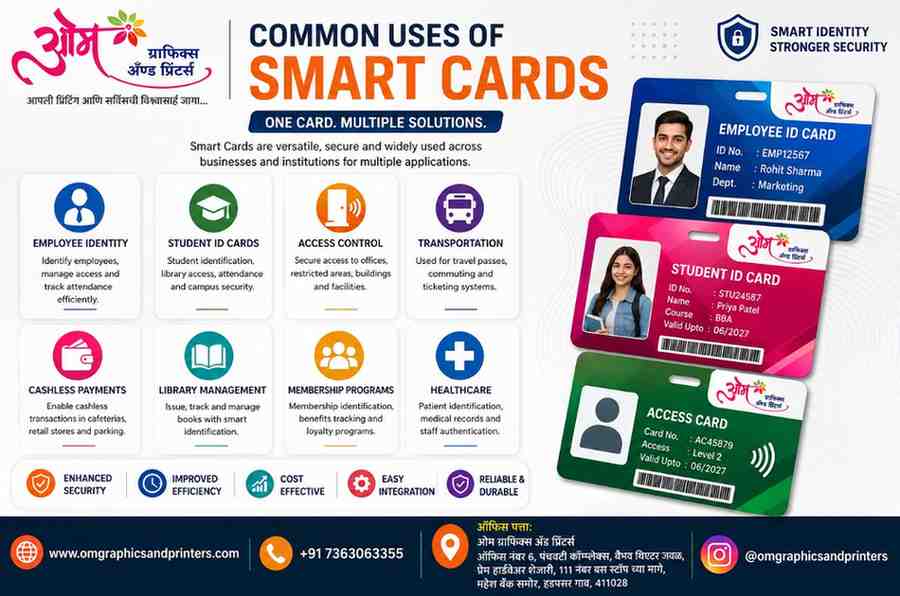
Employee ID Cards
Organizations use smart cards for employee identification, attendance tracking, and access management.
Student ID Cards
Schools, colleges, and universities use smart cards for library access, attendance monitoring, transportation management, and campus security.
Membership Cards
Gyms, clubs, associations, and retail businesses issue smart membership cards to manage member information and benefits.
Access Control Cards
Smart cards help secure offices, residential complexes, laboratories, warehouses, and restricted areas.
Healthcare Cards
Hospitals and clinics use smart cards to store patient information and facilitate quick identification.
Loyalty Cards
Retail businesses implement smart card-based loyalty programs to improve customer retention and engagement.
Features of High-Quality Smart Cards
When investing in Smart Cards, organizations should look for the following features:
Durable PVC Material
Premium PVC cards provide excellent durability and resistance to wear and tear.
High-Resolution Printing
Sharp printing ensures professional appearance and easy readability.
RFID and NFC Compatibility
Advanced wireless communication technologies improve convenience and functionality.
Barcode and QR Code Integration
Additional verification and tracking options can be included for enhanced security.
Custom Branding
Organizations can personalize cards with:
- Company Logo
- Employee Photograph
- Unique Identification Number
- Department Details
- Security Holograms
Data Encryption
Secure data encryption protects sensitive information from unauthorized access.
Industries That Use Smart Cards
Corporate Offices
- Employee Identification
- Attendance Systems
- Visitor Management
Educational Institutions
- Student ID Cards
- Library Management
- Access Control
Healthcare Sector
- Patient Identification
- Staff Authentication
- Medical Record Access
Government Organizations
- Citizen Identification
- Secure Authentication
- Departmental Access Control
Hospitality Industry
- Hotel Room Access
- Guest Identification
- Cashless Transactions
Retail Businesses
- Loyalty Programs
- Membership Management
- Customer Rewards
How Smart Cards Improve Business Efficiency
Modern organizations rely on automation and digital systems. Smart cards play a crucial role in improving operational efficiency.
Reduced Administrative Work
Automated attendance and access control systems reduce manual record-keeping.
Better Security Management
Organizations can monitor and control access to facilities in real time.
Faster Identification
Smart cards allow quick verification of employees, students, customers, or members.
Improved User Experience
Contactless smart cards offer convenience and seamless interaction.
Enhanced Reporting
Integrated systems provide valuable insights through attendance, access, and usage reports.
Smart Cards vs Traditional ID Cards
| Feature | Smart Cards | Traditional ID Cards |
|---|---|---|
| Security | High | Basic |
| Data Storage | Yes | No |
| Access Control | Yes | Limited |
| Attendance Tracking | Yes | No |
| Contactless Use | Available | No |
| Custom Functionality | Extensive | Limited |
| Automation Support | High | Minimal |
The comparison clearly shows why organizations are rapidly adopting Smart Cards over traditional identification methods.
How to Choose the Best Smart Card Printing Service
Selecting the right provider is essential for obtaining high-quality and secure smart cards.
Consider Printing Quality
Choose a service provider that offers high-resolution printing and professional finishing.
Evaluate Technology Options
Ensure support for:
- RFID Cards
- NFC Cards
- Barcode Cards
- QR Code Cards
Check Customization Capabilities
The provider should offer full customization according to organizational branding requirements.
Verify Security Features
Look for providers offering:
- Holograms
- UV Printing
- Security Layers
- Data Encryption Support
Bulk Order Capability
Businesses and institutions often require large quantities. Select a provider capable of handling bulk orders efficiently.
Future Trends in Smart Cards
The smart card industry continues to evolve with technological advancements.
Mobile Integration
Smart cards increasingly work alongside mobile applications and digital credentials.
Biometric Authentication
Future smart cards may integrate fingerprint and facial recognition capabilities.
Advanced Encryption
Enhanced security standards will further protect user data.
Multi-Application Cards
Organizations are adopting single cards that combine identification, attendance, payments, and access control.
Cloud-Based Management
Cloud integration enables real-time monitoring and centralized card management.
Why Businesses and Institutions Need Smart Card Printing Today
In today’s fast-paced digital environment, organizations are constantly looking for ways to improve security, streamline operations, and enhance user experiences. Modern identification solutions play a vital role in achieving these goals by providing secure access, efficient attendance tracking, and reliable identity verification. Unlike traditional ID cards, advanced card systems can integrate with access control, visitor management, and attendance software, helping organizations automate routine tasks and reduce administrative workload.
Businesses use these solutions to protect sensitive areas, monitor employee attendance, and strengthen workplace security. Educational institutions benefit from student identification, library access, campus security, and cashless payment systems. Healthcare facilities, government departments, and membership organizations also rely on these technologies to manage users efficiently and securely.
Key advantages include secure identification, automated access control, attendance management, improved operational efficiency, enhanced brand professionalism, and scalable security solutions. As organizations continue to adopt digital transformation strategies, these smart identification systems provide a cost-effective and future-ready approach to managing people, resources, and facilities. Whether for a small business, school, college, hospital, or large enterprise, they offer greater convenience, security, and operational control in an increasingly connected world.tional institution, healthcare facility, or large enterprise, smart cards offer a cost-effective and future-ready solution.
Conclusion
Smart Cards have transformed the way organizations manage identification, security, attendance, and access control. Their advanced technology, durability, and versatility make them an essential investment for businesses and institutions in 2026.
From employee ID cards and student identification systems to membership programs and access management, smart cards deliver unmatched convenience and security. By choosing high-quality smart card printing services, organizations can enhance professionalism, streamline operations, and prepare for future technological advancements.
As security requirements continue to evolve, the importance of Smart Cards will only increase, making them one of the most valuable tools for modern organizations seeking efficiency, reliability, and long-term growth.
Frequently Asked Questions (FAQs) About Smart Card Printing
1. What Are Smart Card Printing?
Smart Card Printing are advanced identification cards that contain an embedded microchip, RFID chip, NFC technology, magnetic stripe, barcode, or QR code to securely store and process information. Unlike traditional ID cards, Smart Card Printing can perform multiple functions such as authentication, access control, attendance tracking, cashless payments, and data storage.
Smart Card Printing are widely used by businesses, educational institutions, hospitals, government organizations, and membership-based companies to improve security and operational efficiency.
2. How Do Smart Card Printing Work?
Smart Card Printing work by communicating with a compatible card reader or access control system. Depending on the technology used, a smart card may need to be inserted into a reader (contact card) or simply tapped near a scanner (contactless card).
The card securely transmits stored information such as:
- Employee Identification Data
- Student Information
- Membership Details
- Access Permissions
- Attendance Records
- Payment Credentials
This process allows organizations to automate various operations while maintaining high levels of security.
3. What Are the Different Types of Smart Card Printing?
There are several types of Smart Card Printing available for different applications:
Contact Smart Card Printing
Require physical insertion into a reader and are commonly used in banking and secure authentication systems.
Contactless Smart Card Printing
Use RFID or NFC technology and communicate wirelessly with readers.
Hybrid Smart Card Printing
Combine multiple technologies in a single card for enhanced functionality.
Memory Smart Card Printing
Designed primarily for storing information rather than processing it.
RFID Smart Card Printing
Widely used for attendance systems and access control.
NFC Smart Card Printing
Enable quick communication with smartphones and NFC-enabled devices.
Each type offers unique advantages depending on organizational requirements.
4. What Are the Main Benefits of Using Smart Card Printing?
Smart Card Printing provide numerous benefits for organizations and institutions:
- Enhanced Security
- Faster Authentication
- Efficient Attendance Tracking
- Automated Access Control
- Improved Data Management
- Professional Branding
- Reduced Administrative Work
- Better User Experience
- Multi-Purpose Functionality
- Long-Term Cost Savings
These advantages make smart cards a valuable investment for businesses looking to modernize their operations.
5. Why Are Smart Card Printing Better Than Traditional ID Cards?
Traditional ID cards only display printed information and photographs.Smart Card Printing go beyond visual identification by offering digital functionality.
Smart Card Advantages:
- Secure Data Storage
- Access Control Integration
- Attendance Monitoring
- Cashless Transactions
- Encrypted Authentication
- Contactless Usage
- Real-Time Tracking
Because of these features, Smart Card Printing provide significantly greater security and convenience compared to conventional identification cards.
6. Where Are Smart Card Printing Commonly Used?
Smart Card Printing are used across various industries and organizations.
Corporate Offices
- Employee Identification
- Access Control
- Attendance Tracking
Educational Institutions
- Student ID Cards
- Library Access
- Campus Security
Healthcare Facilities
- Patient Records
- Staff Identification
- Secure Access
Government Departments
- Employee Authentication
- Secure Documentation
Hotels and Hospitality
- Room Access Cards
- Guest Identification
Retail Businesses
- Loyalty Programs
- Membership Management
Their versatility makes Smart Card Printing suitable for almost any organization requiring secure identification and management systems.
7. Can Smart Card Printing Be Customized?
Yes. Modern Smart Card Printing can be fully customized to match an organization’s branding and security requirements.
Customization options include:
- Company Logo
- Employee or Student Photo
- Name and Designation
- Barcode
- QR Code
- RFID Chip
- NFC Technology
- Signature Panel
- Holographic Security Features
- Custom Background Design
Customized Smart Card Printing help organizations maintain a professional image while ensuring secure identification.
8. Are Smart Card Printing Secure?
Security is one of the biggest advantages of Smart Card Printing
Advanced Smart Card Printing include:
- Encrypted Data Storage
- Secure Authentication Protocols
- Anti-Cloning Technology
- RFID Protection
- Password Verification
- Multi-Factor Authentication Support
These security features significantly reduce the risk of unauthorized access, identity theft, and data breaches.
9. What Materials Are Used to Make Smart Card Printing?
Most Smart Card Printing are manufactured using durable PVC plastic.
Premium Smart Card Printing may also include:
- Composite PVC
- Polycarbonate Materials
- PET-Based Materials
- Laminated Security Layers
These materials provide durability, water resistance, and long-lasting performance, making them suitable for daily use.
10. What Is the Difference Between RFID and NFC Smart Card Printing?
Both RFID and NFC technologies allow contactless communication, but there are differences.
RFID Smart Cards
- Longer Reading Distance
- Used for Attendance Systems
- Access Control Applications
- Asset Tracking
NFC Smart Cards
- Shorter Communication Range
- Smartphone Compatibility
- Mobile Payments
- Secure Data Exchange
The choice depends on the intended application and system requirements.